To advance large-scale computing and to reduce time to discovery, our research and software development group:
- Enables breakthrough science through co-design with the scientific community,
- Develops techniques to reduce data volumes,
- Creates portable, scalable, and efficient code for modern architectures,
- Optimizes input/output workflows, and
- Provides software verification and reproducibility techniques.
Building Efficiency and Reliability in Scientific Computing
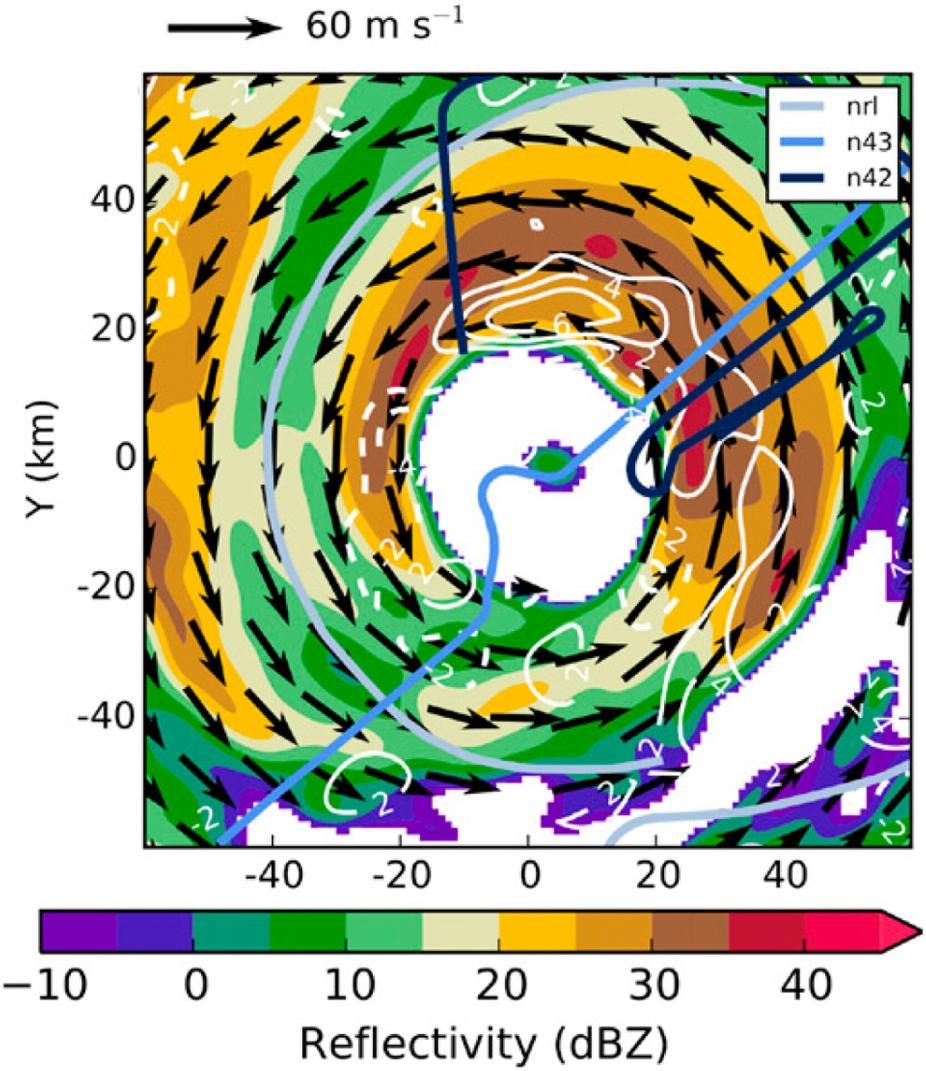
Figure 1. Image taken from Enabling efficient execution of a variational data assimilation application features a horizontal cross section of samurai analysis of Hurricane Rita (2005), adapted from Boehm and Bell (2021), showing radar reflectivity (shaded, dBZ), horizontal velocity (black arrows, m s−1), and vertical velocity (white contours, m s−1) at 5 km altitude at 2040 UTC on 23 September 2005.
As scientific research becomes increasingly reliant on powerful computer simulations, ensuring reliable results and making the most of available computing resources matters more than ever. The NSF National Center for Atmospheric Research’s (NCAR) Applied Computational Science (ACS) team works to address these challenges by developing innovative approaches that make scientific computing more efficient, dependable, and accessible. Its work focuses on improving how scientific software is tested and validated, finding smarter ways to store and manage the vast amounts of data generated by simulations, and helping researchers get more value from increasingly powerful computing systems. Although these efforts tackle different technical challenges, they share a common goal: removing barriers that can slow scientific progress. By strengthening confidence in computational results, reducing the resources needed to manage scientific data, and improving the efficiency of research workflows, the ACS team helps create a stronger foundation for scientific discovery. These advances enable researchers to make better use of modern computing technologies, tackle increasingly complex questions, and focus more of their time and resources on advancing our understanding of the natural world.
Main Areas of Our Work
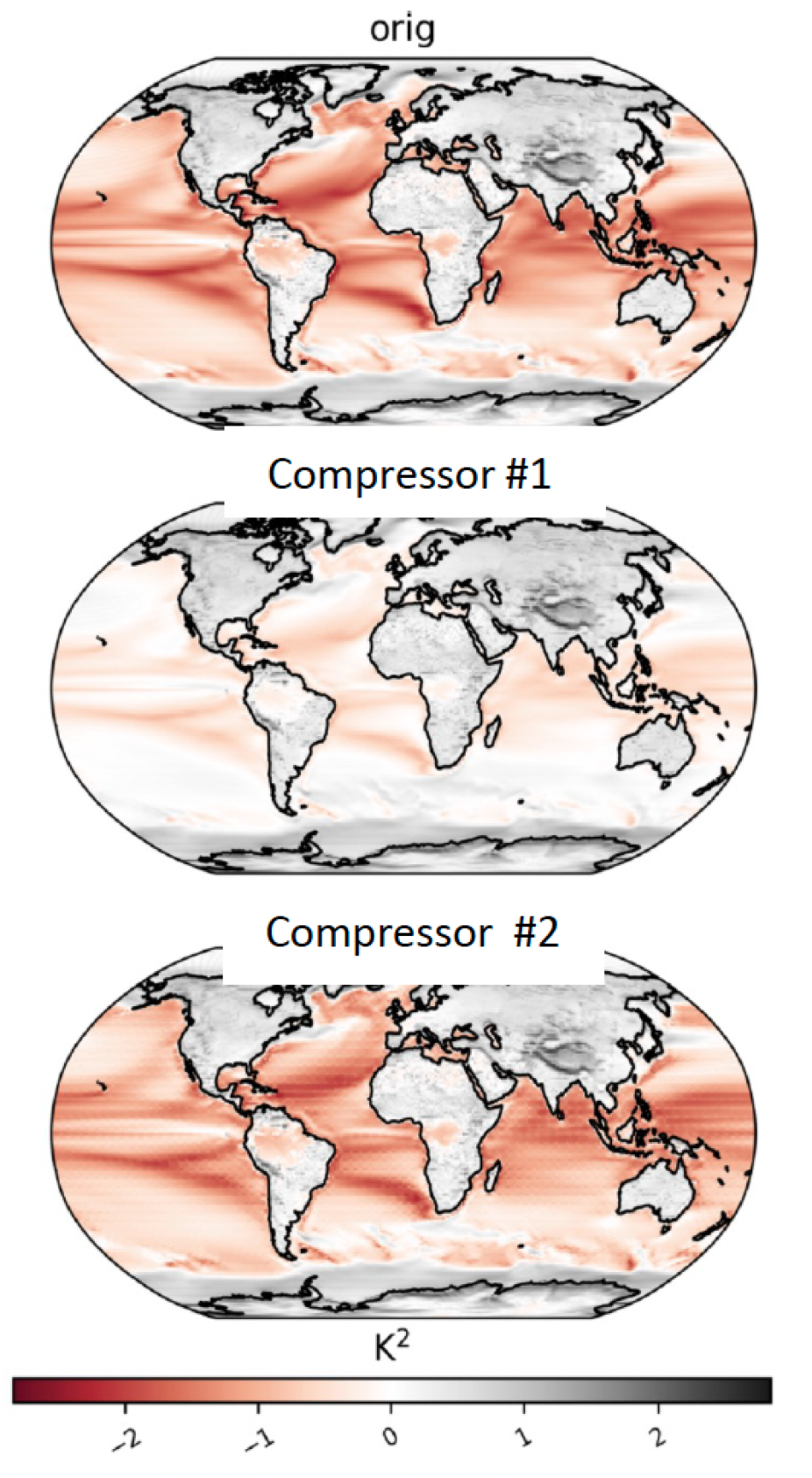
Figure 2. A comparison of N-S contrast variances (to measure fine-scale spatial variability) for surface temperature with two different compressors, as generated by LDCPy.
- High-performance computing and performance portability — Optimizing scientific software to run faster and more efficiently across modern computing architectures, including CPUs and GPUs, enabling researchers to tackle increasingly complex simulations.
- Scientific data management and efficiency — Developing techniques to improve data storage, compression, and input/output performance, reducing the computational and storage costs of managing large simulation datasets while preserving scientifically important information.
- Software verification and reliability — Developing methods to evaluate the effects of changes to scientific software and computing systems, helping ensure that simulation results remain accurate, reliable, and reproducible.
- Scientific application development and collaboration — Working with researchers to improve the performance and scalability of scientific models and applications across weather modeling, Earth system science, and space weather, while supporting broader research and education efforts.
Several of our efforts are tied to the NSF NCAR Community Software Facility (CSF)