Redefining AI's resource usage: How the NWSC facility models responsible supercomputing
by Shira Feldman
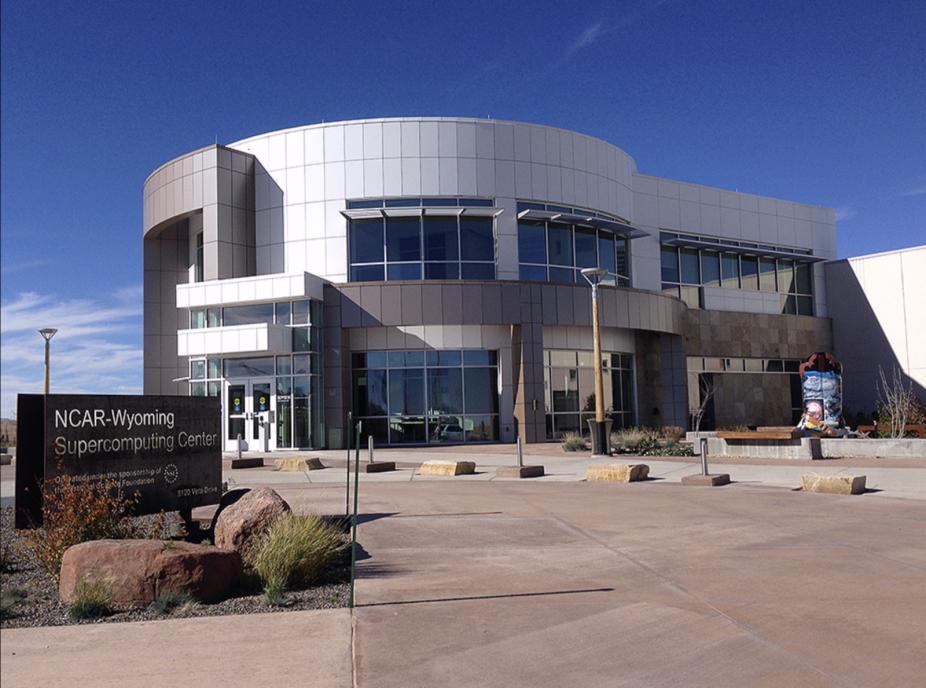
NSF NCAR's award-winning NWSC facility, located in Cheyenne, Wyoming.
Public concern around artificial intelligence often centers on its resource usage footprint, with widespread perceptions that AI workloads are resource-heavy, energy-inefficient, and harmful to the public water supply. Many people picture data centers as massive corporate facilities that drain clean water supplies in drought-prone areas and discharge contaminated wastewater into the community.
"For every dollar of electricity spent at the NWSC, roughly 90 cents directly powers scientific computing and AI workloads."
While public concern around data center water use is understandable, broader context helps clarify its scale. Generating a single AI response to a query consumes roughly a 16-ounce bottle of water for cooling—a tiny fraction of the 700 gallons required to produce one cotton T-shirt.
There is a simple, yet crucial difference that separates these two examples: agricultural products like cotton need a fixed, non-negotiable amount of water to survive and grow, while a data center's water footprint is a variable based on its engineering, not a mandatory requirement. Through factors like natural ambient cooling and optimized infrastructure, engineers can actively design water demand down, ensuring digital systems can run efficiently without draining local resources.
The NSF NCAR Wyoming Supercomputing Center (NWSC) directly challenges these negative public perceptions by offering a clear model for responsible computing. For context, the NWSC is the physical facility in Cheyenne, Wyoming, that houses the hardware, while Derecho is the supercomputer operating inside it.
"The NWSC is a good neighbor both on the grid and at the tap, providing local Cheyenne jobs, public tours, and total transparency."
The NWSC is far from a secretive corporate server farm or a hidden cryptocurrency mine; rather, it is a fully open, community-driven resource. More than 4,000 scientists across 575 universities and research institutions rely on Derecho's massive processing power to run complex Earth system science (ESS) simulations and advance weather forecasting.
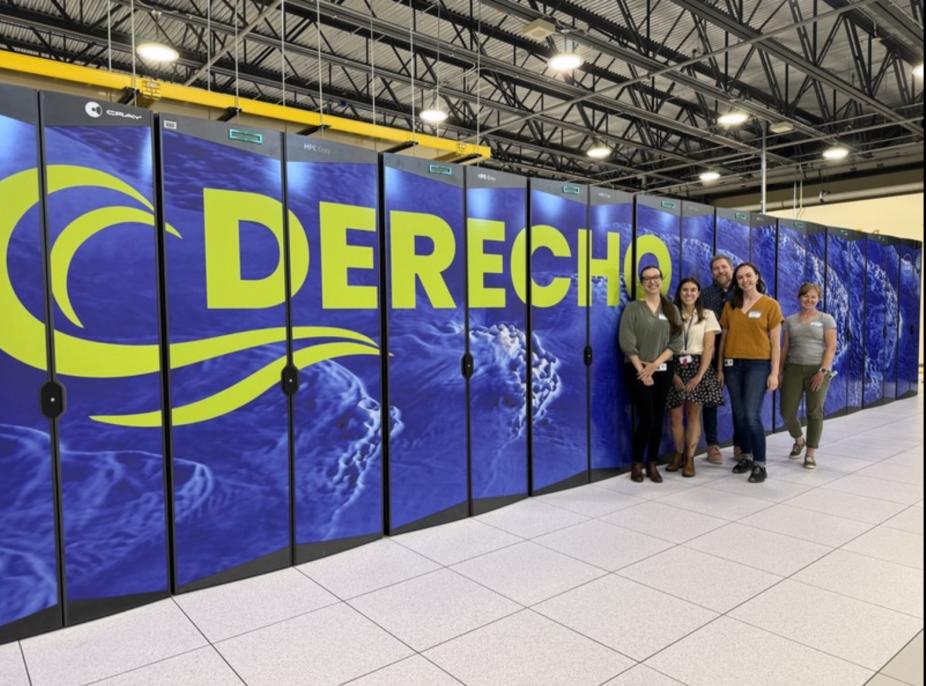
The Derecho supercomputer is housed in NSF NCAR's NWSC facility.
Built on a foundation of public visibility and transparency, the NWSC is a state-of-the-art achievement in scientific engineering—delivering local Cheyenne jobs, responsible Cheyenne water stewardship, and a facility the public is invited to walk through.
NSF NCAR welcomes anyone curious to see how this incredible technology works: visitors are actively invited to explore the center through walk-in exhibits, an interactive 360-degree virtual tour, or by booking an in-person guided tour to see the Derecho supercomputer up close.
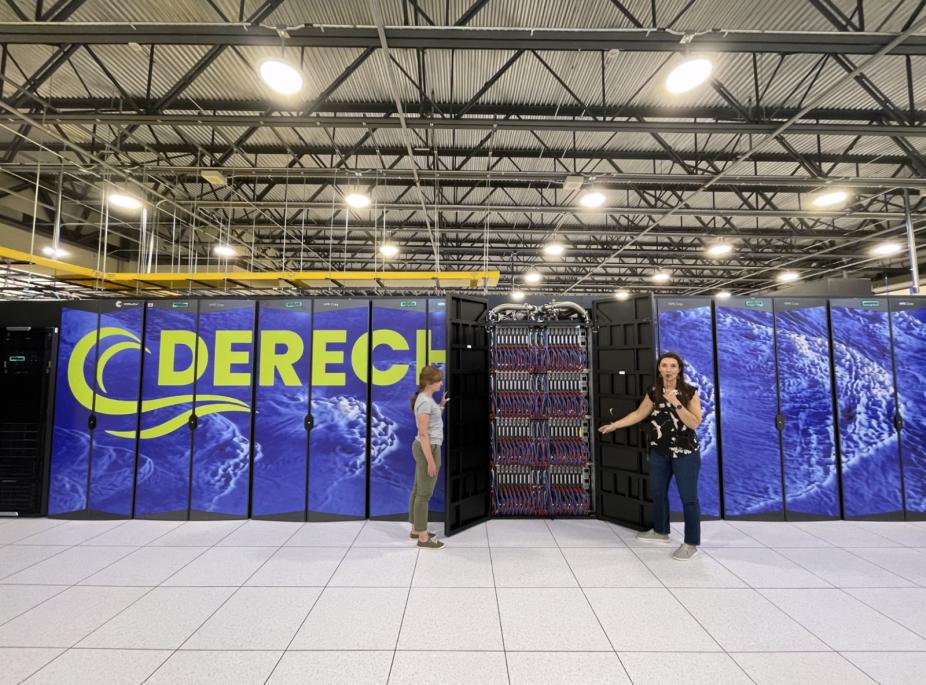
Summer Wasson, Outreach and Training Specialist, gives one of her well-received tours of the NWSC and the Derecho supercomputer. Pictured with Project Manager Karla LeFevre.
Beyond its openness and transparency, the NWSC uses purpose-built, specialized models to advance Earth system science efficiently. By taking advantage of Wyoming's cooler weather and natural winds, the center proves that high-performance computing (HPC) can minimize its water footprint and conserve critical natural resources.
Facility-level resource efficiency: The foundation at NWSC
The NWSC's efficient engineering reflects a straightforward principle: doing this science well means being careful with the water, power, and land that the facility depends on. To validate this commitment, the award-winning facility tracks a metric called Power Usage Effectiveness (PUE).
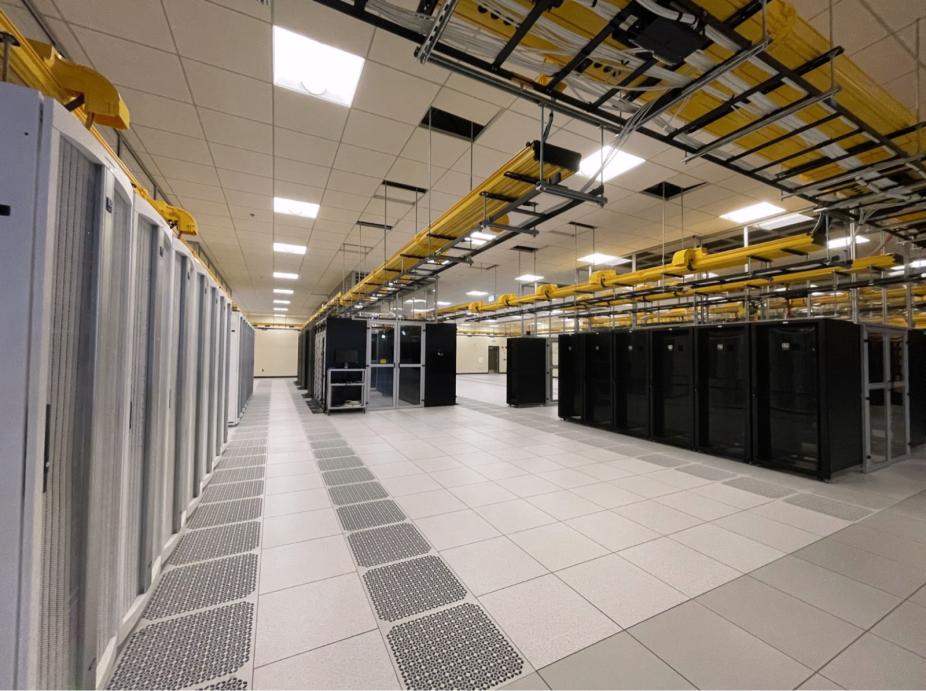
Data center module at the NWSC.

Power Usage Effectiveness (PUE) metric.
The PUE value measures energy efficiency by comparing the energy the data center uses for actual computing against the additional energy the center needs to run and keep cool. While the industry average PUE sits around 1.56—meaning a third of the facility's electricity goes to cooling systems—the NWSC typically operates in an impressive range of 1.06 to 1.11 PUE, minimizing cooling overhead. Put simply: for every dollar of electricity spent at the NWSC, roughly 90 cents directly powers scientific computing and AI workloads.
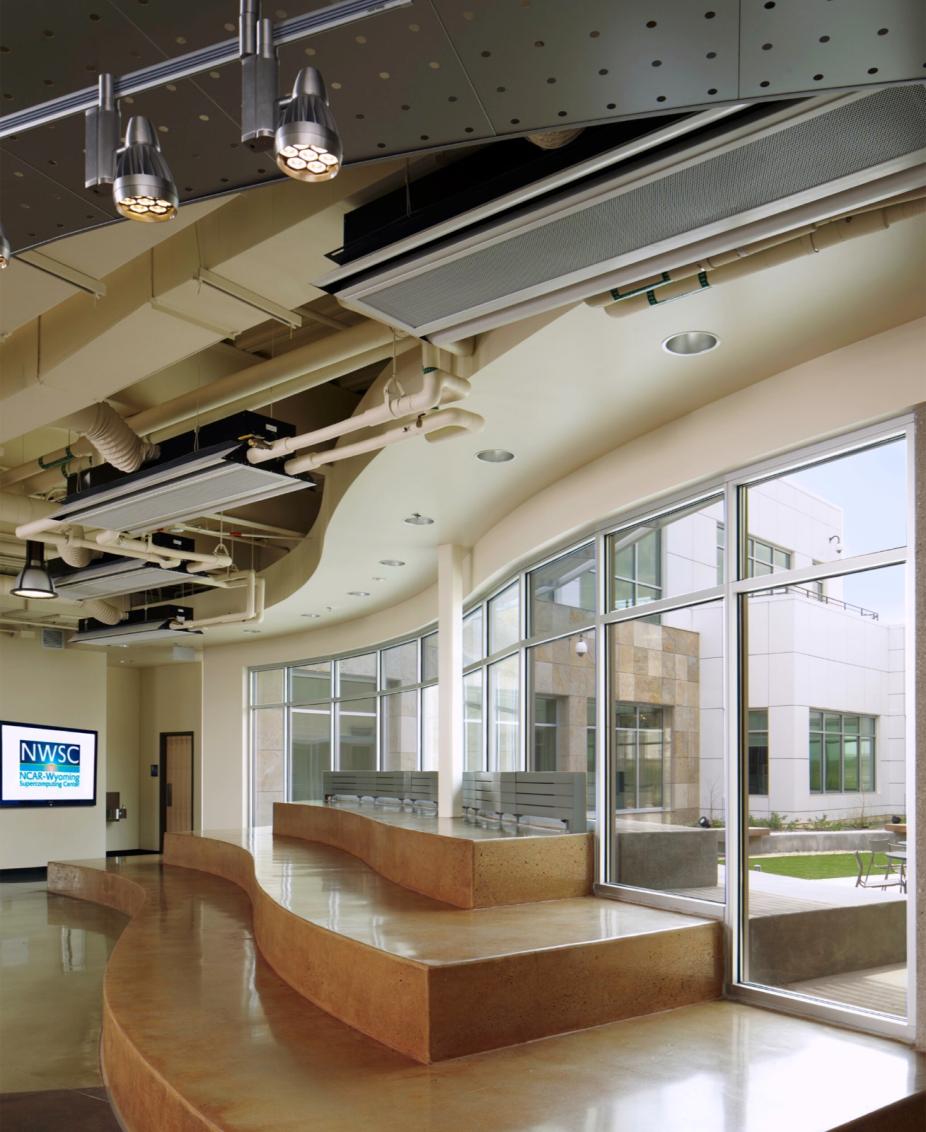
The NWSC's lobby reflects the building's distinctive, beautiful, and functional architectural design.
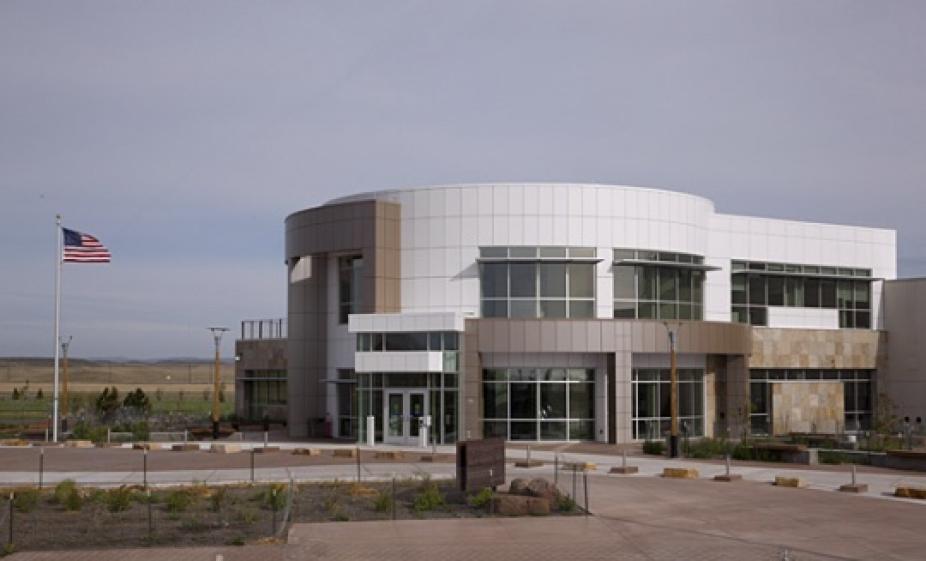
In Cheyenne, the NWSC is a local landmark.
This efficiency stems from a design engineered to harmonize with Wyoming's local weather conditions. The supercomputing center was built to leverage cool, dry, ambient air for free cooling 98% of the year, bypassing energy-heavy mechanical chillers. An optimized hydronic cooling loop reduces water consumption. The NWSC uses an advanced, weather-adaptive loop that requires minimal discharge. While most data centers discharge their water loops, the NWSC remains a responsible steward and only experiences conservative natural evaporative losses and maintaining elite thermal performance, saving up to six million gallons of water per year, and protecting the groundwater that Wyoming's ranches, farms, and communities rely on.
"The NWSC turns its waste byproduct into a functional utility, while efficiently cooling hardware in a way that protects regional water tables."
In addition to resource-efficient cooling, the condensing water loop includes an engineered salt-based water-softening system that strips calcium and magnesium from hard Wyoming water, preventing limestone scale build-up, keeping heat exchangers bare, and extending efficiency and equipment life. By keeping the loop free of mineral scale, the system lets NWSC recirculate its cooling water many more times, reducing the facility's total water use.
What is more, the NWSC achieves greater operational efficiency than venting expensive heat into the atmosphere: the facility was designed to capture the thermal energy generated by HPC and AI workloads, repurposing it to heat the facility and melt snow on exterior sidewalks. This circular approach turns a waste byproduct into a functional utility, while efficiently cooling hardware in a way that protects regional water tables. NWSC proves high-density atmospheric research can co-exist with resource conservation.
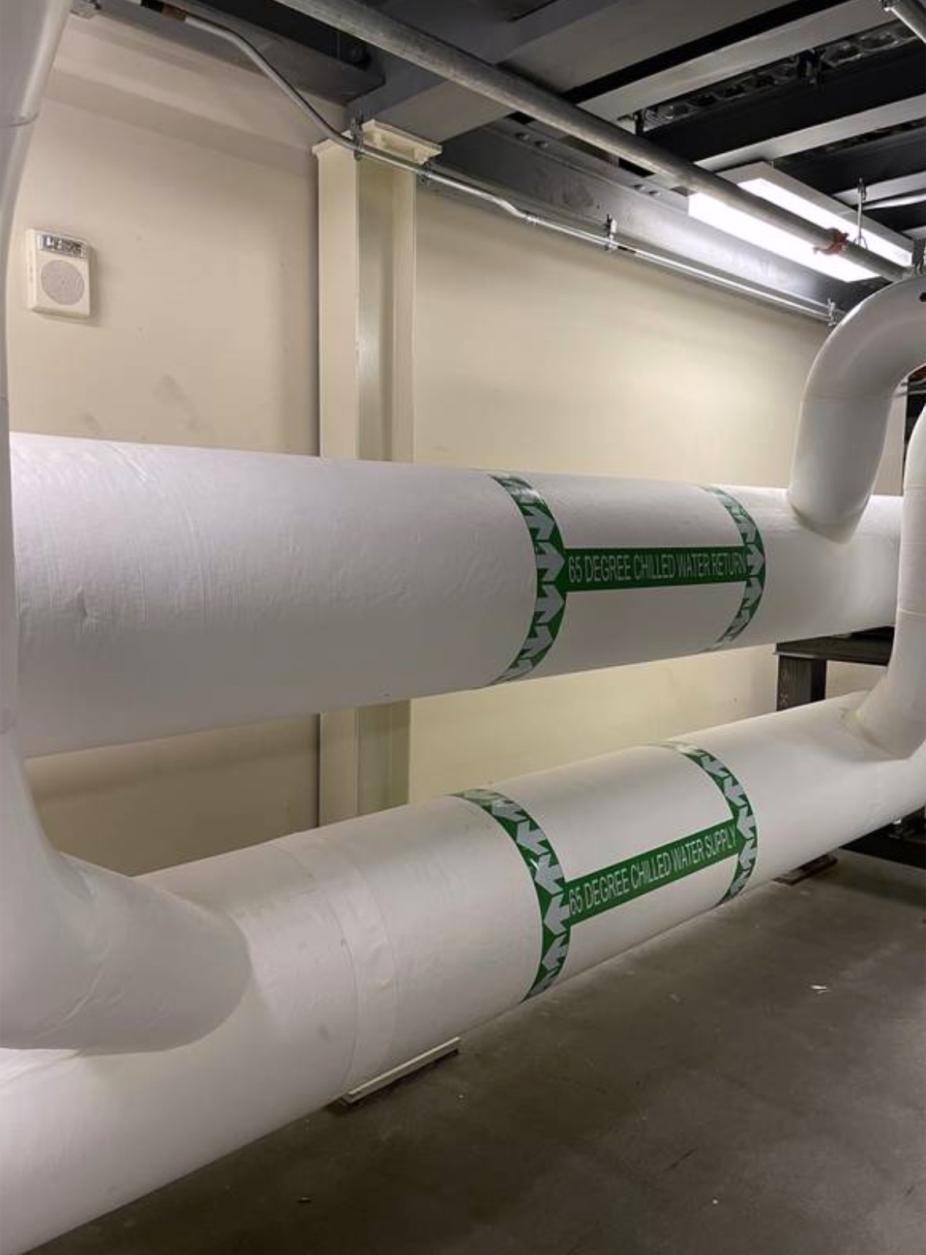
Pipes involved in the resource-efficient water loop at the NWSC.
Chip-level efficiency: Derecho's hardware innovations
While the facility manages macro-level cooling and power, the Derecho supercomputer achieves resource efficiency at the hardware level through targeted technological design:
- Direct-to-Chip Liquid Cooling: Liquids conduct heat roughly 25 times more effectively than air; by using liquid cooling directly at the hardware level, Derecho can pull heat directly off the chip using far less energy than air cooling.
- Powered Efficiency: AI workloads generate intense heat spikes compared to traditional Earth system models. To meet these demands efficiently, Derecho relies on 328 NVIDIA A100 GPUs to execute parallel AI calculations with significantly higher energy efficiency than traditional CPUs.
Targeted AI solutions: Purpose-built for Earth system science
Purpose-built to advance Earth system research, NSF NCAR's specialized AI applications sharpen forecast accuracy—delivering vital early warnings for severe blizzards, droughts, and wildfires that endanger regional livestock, crop yields, and local ecosystems. Unlike the massive, general-purpose Large Language Models (LLMs) that currently dominate news headlines, Earth system science AI is much smaller, tailored specifically for its research goals, and built purely for scientific progress.
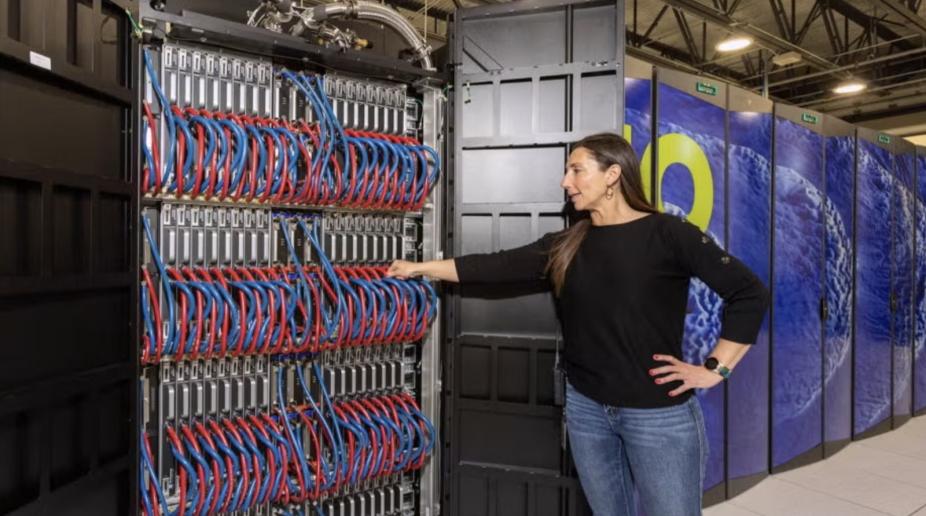
During a tour, Summer Wasson showcases Derecho's technological design.
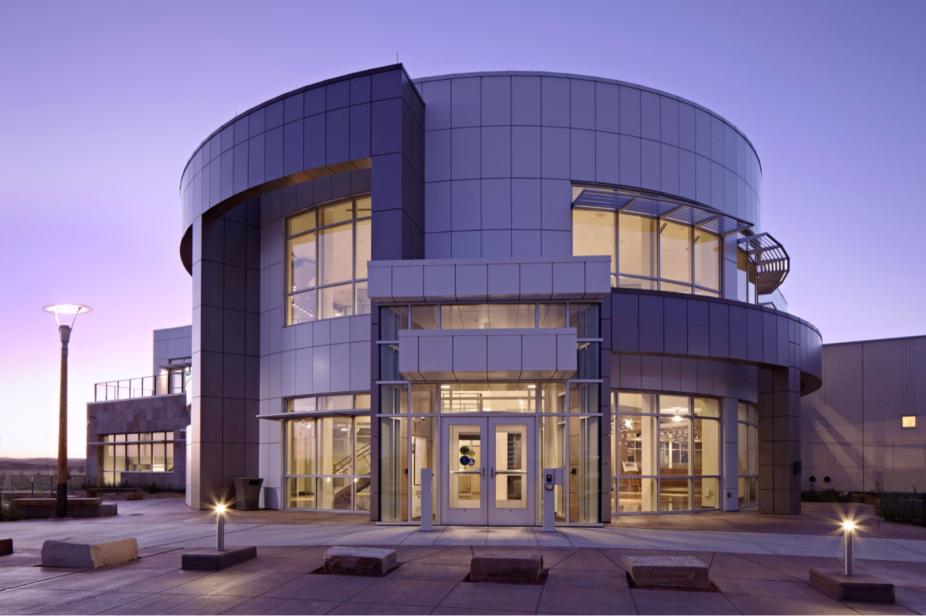
The NWSC earned its LEED Gold certification from the U.S. Green Building Council by combining extreme energy efficiency with sustainable construction.
NSF NCAR's focused AI tools deliver clear, reliable forecasts that directly support local communities, wildlife, and working lands. These specialized AI resources help ranchers plan around droughts and storms, give towns early warnings for blizzards and wildfires, and keep rivers and open country healthy for hunters, anglers, and outdoor families. By giving irrigators, outfitters, and wildlife managers the insights they need, NSF NCAR helps keep working lands open and productive.
Work conducted at the NWSC treats both energy and water as precious resources, ensuring not a single drop or unit of power is squandered. By taking only the water the facility needs and returning the rest—following the same principle that guides every water right in the state—the facility operates with care, protecting the rivers, streams, and reservoirs that downstream communities and recreation depend on.
"The NWSC treats both energy and water as precious resources, ensuring that not a single drop is squandered, and treating the local Cheyenne community with care."
AI emulators such as CREDIT, CAMulator, and subCESMulator take smart shortcuts to run complex calculations, delivering accurate scientific results while using far less energy than traditional physics models. NSF NCAR also reduces energy waste by letting researchers share a single central supercomputing hub rather than building separate systems.

CREDIT, or the Community Research Earth Digital Intelligence Twin, is one example of an AI emulator from NSF NCAR that reduces energy consumption compared to conventional AI models.
In addition, NSF NCAR and UCAR are paving the way in establishing best practices across the field, thus avoiding wasted compute from duplicated or silently failing models. Through this thought leadership role, NSF NCAR helps ensure that all available computational resources are maximized toward meaningful scientific advancement.
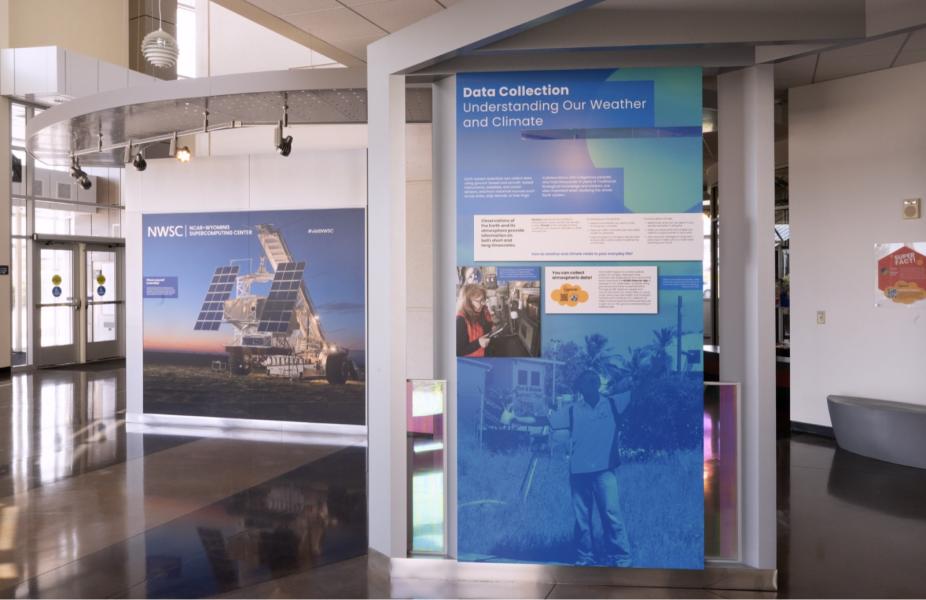
The NWSC's Visitor Center, which also serves as an exhibit and gallery space open to the public Monday through Friday, 9:00 am - 5:00 pm, without appointment.
NSF NCAR brings together NWSC's advanced facility infrastructure; Derecho's direct-to-chip cooling and GPU efficiency; a recirculating cooling loop that conserves water; water-conserving cooling powered by Wyoming's cooler, drier air; and mission-driven efficiency for scientific computing.
These features demonstrate that cutting-edge AI research and responsible resource use can coexist.
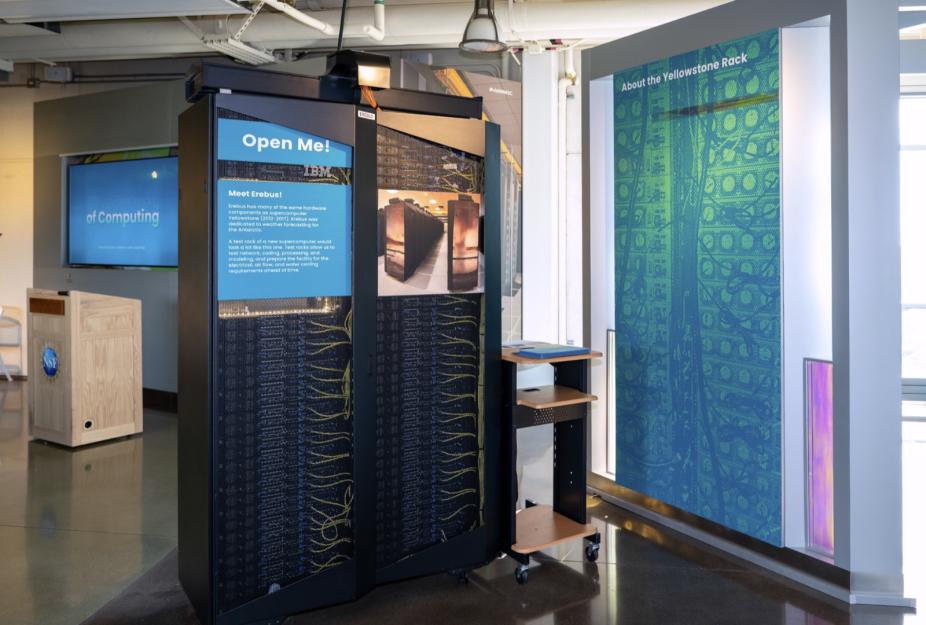
The exhibits in the NWSC Visitor Center provide both education and entertainment for its many visitors.
Ultimately, the NWSC is a good neighbor both on the grid and at the tap, providing local Cheyenne jobs, public tours, and total transparency. In doing so, the NWSC delivers vital scientific solutions without draining the community's water or disrupting its lifestyle.