2026 SIParCS interns conduct cutting-edge research at Mesa Lab
by Shira Feldman
The Summer Internships in Parallel Computational Science (SIParCS) program for 2026 is currently in full swing at CISL's Mesa Lab.
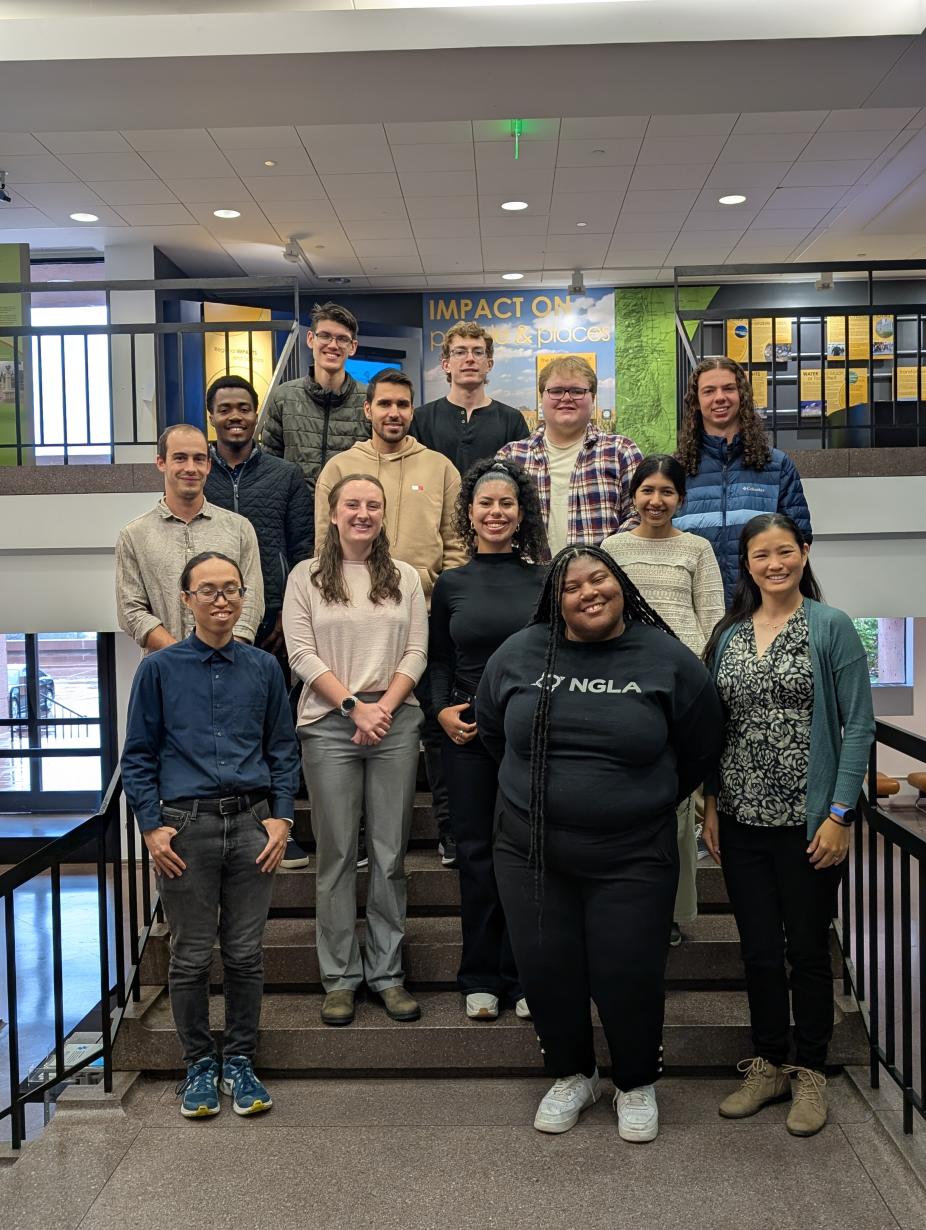
The 2026 SIParCS intern cohort poses at the Mesa Lab.
Pictured at right, 14 talented students from various universities and academic backgrounds across the country are spending the summer at the Mesa Lab in Boulder, Colorado, working on cutting-edge computational and data science projects.
The 2026 SIParCs program kicked off on Monday, May 18, with an on-site welcome and lunch at the Mesa Lab, followed by a communication planning session. The program will conclude on Friday, July 31.
To provide a more consistent and robust experience for all interns across NSF NCAR, UCAR, and UC, the SIParCS program this year has partnered with two other key NSF NCAR intern programs:
-
NESSI—NSF NCAR Earth System Science Internship, hosted by EdEC, NSF NCAR’s Education, Engagement and Early-Career Development division.
-
NSF SOARS—NSF Significant Opportunities in Atmospheric Research and Science.
Thanks to this collaboration, a comprehensive orientation filled the interns' first week, launching them into a strong, unified start.
The 2026 SIParCS projects
The project list below showcases the interns' versatility to tackle important questions in computational science, machine learning, and data engineering:
- Anna Scribner (North Seattle College)—"Natural Language Discovery of NSF NCAR Scientific Data"
- LJ Dunphy (Florida State University)—"AI Weather and Atmospheric Chemistry Prediction with Physical Constraints"
- Ira Ranjan (Plymouth State University)—"FastOSSE: A New Tool for Optimizing Ocean Observing Networks"
- Dusti Johnson (Washburn University)—"Data Pathfinders: A GDEX UX/UI Intern Quest"
-
The Summer Internships in Parallel Computational Science (SIParCS) program is hosted by NSF NCAR's Computational and Information Systems Lab (CISL).
Max Jessey (Tennessee Technological University)—"Learning to Fight Wildfires: Reinforcement Learning for Fire Suppression in a Forest Fire Model"
- Ethan Campbell (University of North Carolina at Charlotte)—"AI Nowcasting Models for Predicting the Evolution of Convective Storms"
- Tri Nguyen (Indian University, Bloomington)—"CIRRUS – Developing Workflows for Validating Cloud Native Deployments"
- Obin Sturm (University of Southern California)—"Simulating Atmospheric Chemistry with MUSICA in Julia"
- Nathan Bartley (Texas Tech University)—"Improving the Code Infrastructure of the NSF NCAR Air Quality Sampling Drone System"
- Xin Guan (The Ohio State University)—"Improving Uncertainty Estimates in Earth System Prediction with DART"
- Pouya Shaeri (Arizona State University)—"OpenIoTwx Dynamic AI-Mesonet, Edge Computing, and Cyber Infrastructure Integration"
- Liam Thompson (University of Oklahoma)—"Generalized Framework for the Evaluation and Comparison of Atmospheric Chemistry Models with Observations"
- Riley Fisher (University of Colorado Boulder)—"Developing a Mini-App with the JAX Python Library and/or Rust Programming Language"
- Gabrielle Forbes (West Chester University)—"CISL Outreach, Workforce Development, Education (CODE)"
To learn more about the interns' work, visit the SIParCS 2026 project descriptions.